
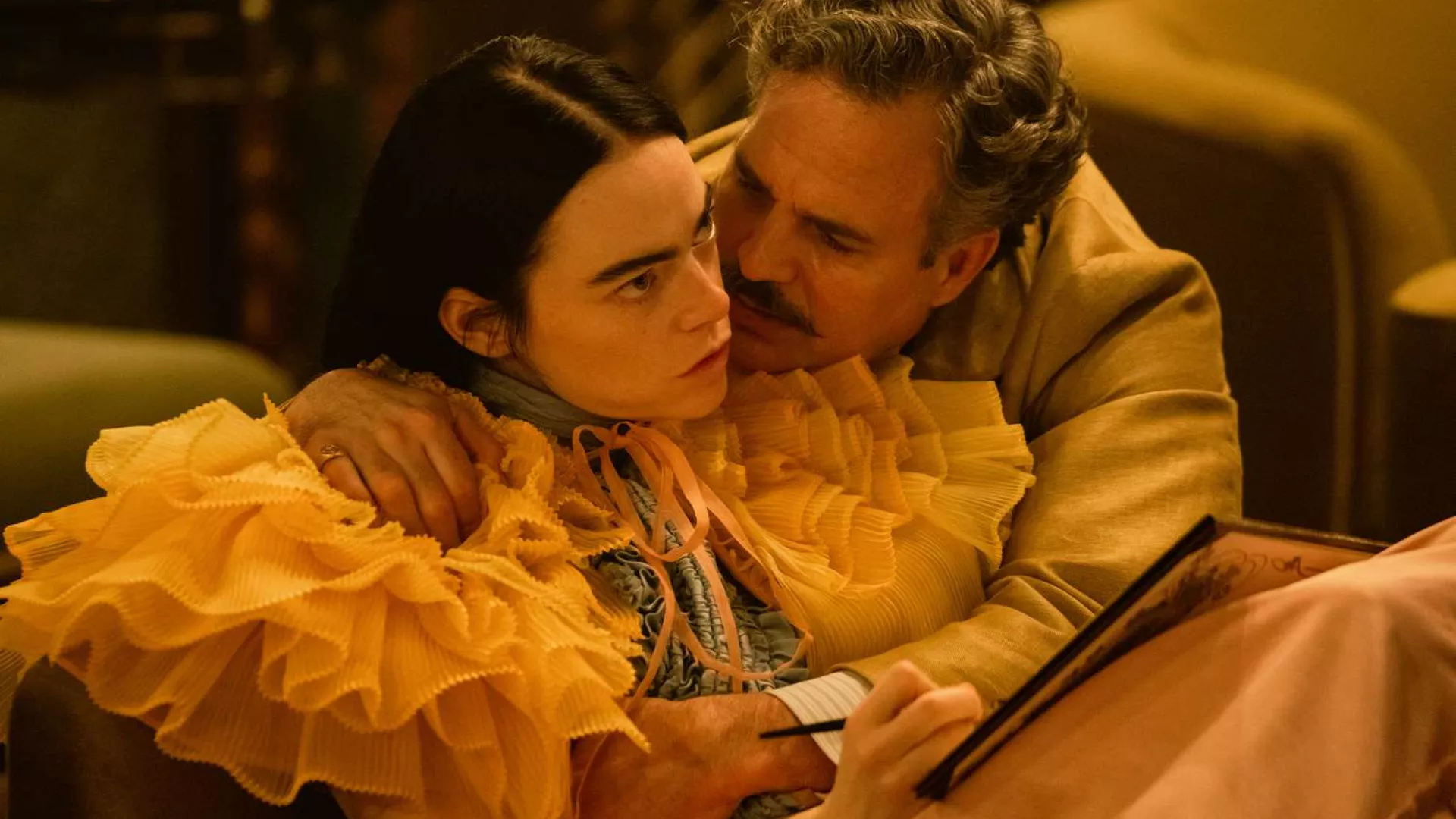

I find Yorgos Lanthimos to be a fascinating filmmaker, although it’s generally difficult to say that one “loves” his movies. His films are satirical and often bleak, but also frequently funny — in a painful kind of way. He is sharp observer of social customs and human interaction, and he seems to enjoy making the kinds of stories where poor ordinary souls are caught in absurd situations, without realizing how absurd their situations are. In his movies, the absurd is commonplace, and much of the satirical humor comes from the way people accept the strangest of occurrences as simply “the way things are.”
I’ve enjoyed every Lanthimos film I’ve seen, by some measure. Dogtooth, The Lobster, and The Favourite are all by turns chilling and amusing. The Killing of a Sacred Deer, on the other hand, is one of the most unexpectedly horrific films I’ve ever seen.
Poor Things, then, ranks as Lanthimos’s most cheerful and life-affirming movie – even if it’s also cheeky, perverse, and sharp enough to cut glass. Furthermore, it’s Lanthimos’ most technically accomplished film; where his earlier works set their absurdist storylines against neo-realist backdrops, this one is awash in a highly eccentric, fever-dream version of the Steampunk aesthetic — an alternate-universe version of Victorian Europe, where odd scientific advancements co-exist with weird and colorful twists on that era’s fashions and social customs.
Emma Stone (La La Land) leads this Frankenstein-like tale – (or should that be “Bride of Frankenstein?”) – in which a deceased woman has been brought back to life with the mind of an infant. This miracle of science has been performed by the hideously disfigured Dr. Godwin Baxter (Willem Dafoe). He has named her Bella, and he has paternal feelings for her. She toddles awkwardly, caws in monosyllables, and calls him God.
Because he cannot watch Bella constantly, Dr. Baxter hires one of his medical apprentices — Max McCandles — to attend to her, and to “record her progress.” Max is a gentle and naive young man, who is around Bella’s own physical age. These facts seemingly make him a good romantic-match for Bella — a possibility of which Dr. Baxter seems prudently aware, maybe even approving. But also, Max is the only man Bella has ever known, besides Godwin.
And so, progress Bella does — up to a point. But things get complicated when another man — a devilish cad named Duncan Wedderburn (Mark Ruffalo) – enters the picture, and Bella discovers the pull of sexual desire.
Boy, is this film interested in sexual desire — the odd comedy of it, the way in which it complicates us, the strange kind of power that it holds, the absurd way in which it undercuts our most evolved notions about ourselves. Neither Lanthimos nor his actors are shy about this aspect of the film, and although I wouldn’t exactly call the movie “titillating” — as its many sex-scenes feel more satirical than sexy — there’s plenty here to make a Puritan blush. If you couple the notion of Bella’s sexual awakening with the notion that she is LITERALLY a 5 or 6-year-old in a grown woman’s body, there emerge some very icky undertones that the film is very aware of.
This leads to my one major misgiving about this film, which is the fact that much of its comedy co-exists with some pretty queasy undercurrents. The film’s awareness of this won’t excuse it for all viewers — but, as one character humorously observes: “All sexuality is immoral.”
And ultimately, there is much more to this film than I’ve yet described. Bella’s hunger for worldly experience leads her to philosophy and social-causes, just as readily as it leads her toward other men, and toward the realization that many of those who claim to love her simply want to exert ownership over her.
The basic storyline of this film has much in common with Pygmalion, the George Bernard Shaw play which was later remade as a musical, “My Fair Lady.” All are stories about women who are “made by” men — men who are then spurned when they realize they cannot own what they feel they have created. But Lanthimos and his crew made this story resonate, for me, much more than those earlier versions of this tale ever did. And it must be said, the kind of imagination and technical wizardry that they brought to the visuals — and to the idiosyncratic use of music, which I could write a separate essay about — really breathed the stuff of life into this telling.
Of course, Emma Stone’s performance as Bella deserves special mention. The film required a certain special magic to make this character work. At its worst, a character like Bella might have come across as another groan-inducing portrait of a mentally-disabled person by a non-disabled actor. But Stone locates a real sense of childlike wonder and chaos within Bella in those early scenes. In the way she walks, in her strange shifts of mood, her sudden outbursts of violence followed by giggles, we do get a very real sense of what it might be like to be a toddler coming to grips with a grown woman’s body.
As Bella learns and matures through her experiences, the way Stone modulates her performance, and gradually refines her body-language and manner of speech — well, it’s so subtle you almost don’t notice, until suddenly you realize that Bella has been speaking full and intelligent sentences for awhile, and that she no longer walks like a toddler, and you can’t quite recall the moment where that transition happened.
By the ending of the film, Bella has become an incredibly unique and memorable character, and much unlikely poetry (and stinging comedy) has been revealed through her journey.

